
Learning the Arabic alphabet is the first step toward reading Arabic, but learning the alphabet does not simply mean memorizing 28 letters.
To become a good reader, you need to learn how Arabic letters look, how they sound, how they are written, how they change inside words, and how they connect with other letters.
Then you gradually move from letters to sounds, from sounds to words, from words to sentences, and finally to real Arabic texts.
The good news: you do not need to learn everything at the same time. A clear order and regular practice make the process much easier.
Start With the Isolated Form of Each Letter
When you first start learning Arabic, do not begin with long words or complicated writing rules. Start with the letter itself.
Arabic letters can have different forms depending on where they appear inside a word. You will study those forms later. At the beginning, focus on the isolated form - the form you see when the letter is written by itself.
Look carefully at each new letter. Notice its lines, curves, dots, and other details. Try to identify what makes it different from other letters.
See the Shape
Notice the structure, curves, lines, and dots.
Hear the Name
Learn how the letter itself is named.
Hear the Sound
Learn the sound you will need when reading.
You should also watch how the letter is written. Pay attention to where the movement begins and how the main parts of the letter are formed.
If you would like to practice this first stage online, Abjadia provides free tools for learning letter shapes, names, sounds, writing, recognition, and review. We will show you how to use these tools at the end of this guide.
Write the Letter Yourself
Watching a letter being written is helpful, but writing it yourself creates a stronger connection between what your eyes see and what your hand remembers.
Do not try to produce beautiful Arabic handwriting yet. Your first goal is much simpler: understand the basic structure and produce a clear, recognizable letter.
If you are using paper, copy the letter several times while looking at a clear example. If you are using a touchscreen or a tablet, you can practice using your finger or a digital pen.
Try this: write the letter several times while looking at the example. Later, hide the example and try again from memory.
Do Not Try to Learn All 28 Letters at Once
One of the most common beginner mistakes is trying to memorize the complete Arabic alphabet in one or two study sessions.
You may be able to repeat the letters in order after doing this, but that does not necessarily mean you can recognize each letter when it appears by itself.
Memorizing the alphabet in order is not the same as recognizing the letters. Your goal is independent recognition, not only recitation.
Learn a small group. Listen to the letters. Say them. Write them. Mix their order. Test yourself. Then add the next group when the first one begins to feel familiar.
Train Yourself to Recognize Similar Letters
Arabic contains several groups of letters that share similar basic shapes. Sometimes one dot changes the letter. Sometimes two or three dots make the difference. In other cases, the position of the dots matters.
This means your eyes need training, not only your memory.
At first, you may consciously count the dots or inspect every part of the shape. With enough exposure, you will start recognizing the complete letter automatically.
Use Different Types of Practice
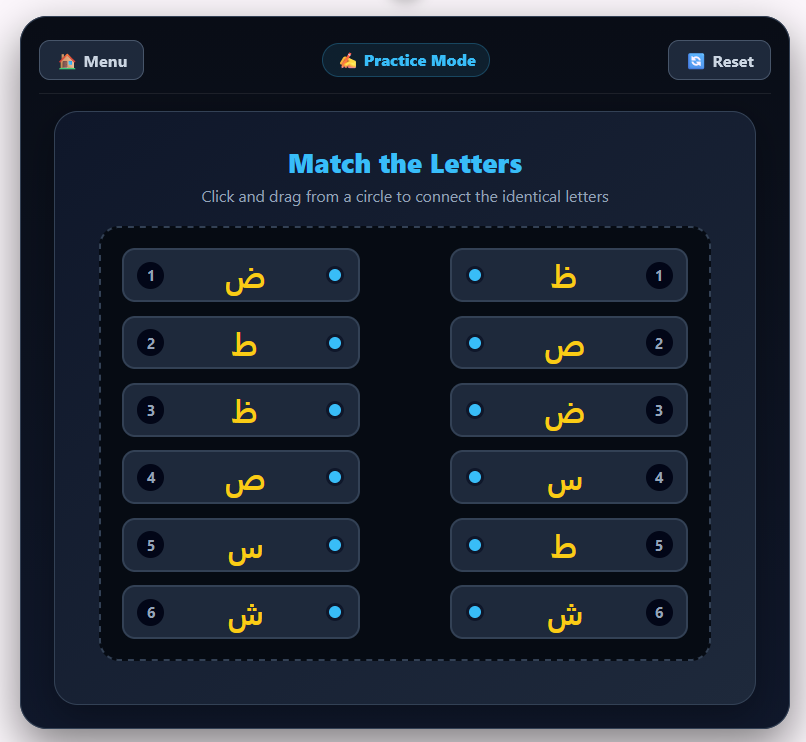
Do not always practice letters in exactly the same way. Sometimes identify the letter from its shape. Sometimes hear a sound and choose the correct letter. Sometimes compare similar letters or match identical forms.
This variety helps you move from simple memorization toward faster and more automatic recognition.
Learn Both the Letter Name and the Letter Sound
Some beginners learn only the names of Arabic letters. Others focus only on the sounds. It is useful to learn both.
This helps you identify the letter and talk about it when learning.
This is the connection you need when you begin reading words.
Some Arabic sounds may be close to sounds in your first language. Others may be completely new. Listen carefully, repeat, and compare your pronunciation with the original sound.
Do not worry if every difficult Arabic sound is not perfect on your first day. Pronunciation improves through repeated listening and imitation.
Review Before Moving to the Next Group
Do not treat a letter as finished because you studied it once. Before moving forward, check whether you can recognize the letters when they appear in a random order.
Recognition
Can you identify the letter without seeing the alphabet in order?
Recall
Can you remember its name and sound without help?
Writing
Can you produce a recognizable form from memory?
Use different types of review before moving to a new group. You can use flashcards, listening activities, writing practice, matching exercises, or short tests.
Learn How Letters Change Inside Words
After you become comfortable with the isolated forms, the next major step is learning how Arabic letters look when they appear inside words.
A letter may look slightly different at the beginning, in the middle, or at the end of a word.
You are not learning a second alphabet. These are different forms of letters you already know.
Learn the forms gradually and look at many examples. You will also discover that some letters do not connect to the letter that follows them.
With practice, connected Arabic will stop looking like one long shape. You will begin seeing the individual letters inside each word.
Start Learning the Short Vowels
After learning the letters and their different forms, you are ready to study the three main short vowel marks: Fatha, Damma, and Kasra.
There are two common approaches to learning them.
Learn one vowel and apply it to many letters before introducing the next vowel.
Take one letter and practice it with Fatha, Damma, and Kasra before moving to another letter.
Both approaches can work. The important thing is to connect the written letter, the vowel mark, and the sound you produce.
Understand Short and Long Vowel Sounds
Once the short vowels feel familiar, begin learning the difference between short and long vowel sounds.
Train both your eyes and your ears. Look at the written form, listen to the sound, repeat it, and compare the short version with the long one.
Do not only memorize the rule. Try to hear the difference and produce it when you read.
Add Sukoon, Shadda, and Tanween Gradually
After the basic vowels, add other important reading signs such as Sukoon, Shadda, and Tanween.
Do not study all of them in the same lesson. Introduce one idea, practice it in simple examples, and then move to the next one.
Do not collect rules. Build skills. Knowing the definition of a reading rule is not enough if you cannot recognize and use it while reading.
Start Joining Two Letters
This is where reading really begins.
Start with two-letter combinations. Identify the first sound, move to the second, and try to blend them together smoothly.
At first, the process may be slow. You may see a letter, remember its name, then think about its sound.
With repetition, those extra mental steps begin to disappear. You see the written letters and read the sound more directly.
Move From Two Letters to Real Words
After two-letter combinations, begin with simple three-letter words. Choose words that use letters and vowel patterns you already know.
Read the word slowly. Read it again. Then try to make each reading smoother than the previous one.
Do Not Depend on Transliteration for Too Long
Transliteration can support a complete beginner, but it should not become your main reading system.
If you always look at the Latin-letter version first, your eyes may learn to ignore the Arabic.
Your long-term goal is simple: See Arabic → Read Arabic.
Move From Words to Sentences
When simple words become comfortable, begin joining them into very short sentences.
At this stage, do not focus only on pronunciation. Try to understand what the sentence means too.
Listen While You Read
When possible, listen to the same sentence you are reading. Follow the Arabic text while listening, pause, read it yourself, then compare your pronunciation.
Reading and listening together can improve pronunciation, rhythm, speed, and listening comprehension at the same time.
Review the Complete Alphabet
A complete alphabet chart can feel overwhelming on your first day. It becomes much more useful after you have already studied the letters individually.
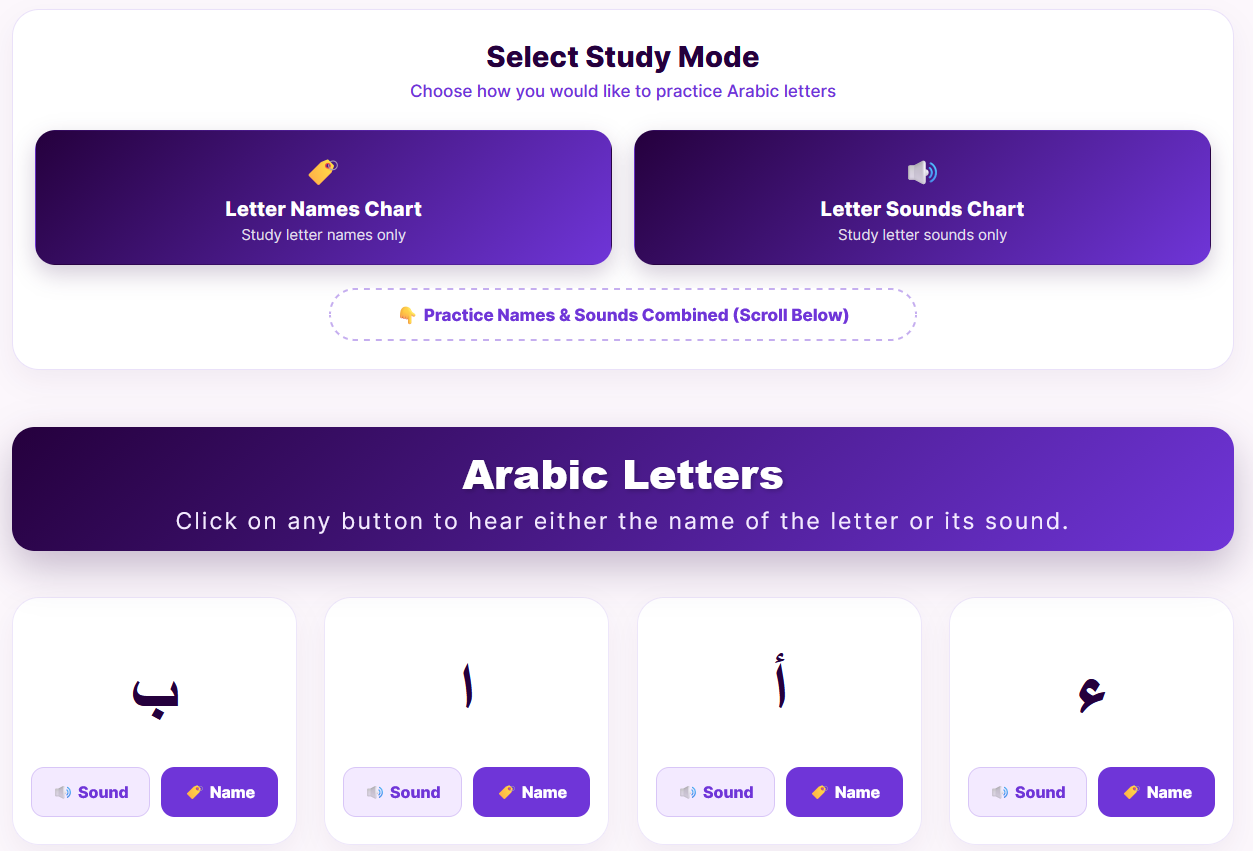
At this stage, review the alphabet in several ways. Sometimes focus only on recognizing the shapes. Sometimes recall the names. At other times, concentrate on the basic sounds.
Letter Names
Check whether you can identify every letter by name.
Letter Sounds
Review the basic sounds you will use when reading.
Combined Review
Connect the visual form, letter name, and sound together.
Take a Comprehensive Alphabet Test
A full test is useful after you finish all the small groups. Letters that seemed easy in a group of four or five may become more difficult when they appear among all 28 letters.
Use the results to identify weak letters, then return to those letters and review them again.
Move From Sentences to Real Arabic Texts
Once sentences feel comfortable, begin reading short paragraphs. Choose texts with familiar vocabulary and simple structures.
Read the same paragraph more than once. During the first reading, focus on decoding. During the next reading, focus more on meaning. Then try to read it more smoothly.
Next: Short Stories and Simple Articles
Short stories are useful because context can help you understand unfamiliar words. Simple articles written for learners are another good next step.
Try not to translate every single word. Learn to understand the main meaning of the text.
Finally: Longer Texts and Books
Books should not be your first reading goal. They are a later result of all the smaller skills you built before.
Common Mistakes to Avoid
Your Arabic Reading Roadmap
If the complete journey feels long, keep this simpler roadmap in mind.
Put the First Stage Into Practice With Abjadia
The first part of this roadmap is not only about memorizing the alphabet. You need to see the letters, hear them, write them, recognize them in different activities, and test yourself regularly.
Abjadia provides these tools online for free, so you can use the platform to practice the first stage of your Arabic reading journey in a more interactive way.
1. Learn Each Letter
Begin with the letter itself before moving to connected forms.

2. Practice Writing It Yourself
Move from watching the letter to producing it yourself.

3. Train Recognition With Practice and Games
Knowing a letter is different from recognizing it quickly.

4. Review the Complete Alphabet
After finishing the individual letter groups, bring the complete alphabet together.
Ready to Start With the First Letters?
You do not need to complete the entire roadmap today. Start with a small group of letters, practice them well, and continue only when they begin to feel familiar.
Start Learning the Arabic Alphabet Free →

